Thursday, February 21, 2013

Make Your Characters Real

 THE CREATIVE PROCESS
It's easy to fall into the trap of not fully "fleshing out" our characters.  Even with strong GMCs, our characters can still be flat and uninteresting.  And boring characters will have readers closing the book.

What does "fleshing out" mean?

Fleshing out means to expand or become more substantial.  For writers it means making characters more human.  There's nothing worse than a perfect person...or a perfect character.  And that's as if there really was a perfect person.  We do try, but we're human...and that's what the characters in our stories should be.

Each character must have, well, character.  After all, that's why they're called characters. ;)  Character is made up of different things.  Because no one (especially our characters!) is perfect, there are both positive and negative traits within our personalities, just as we have strengths and weaknesses.
  • Human Traits
  • Strengths
  • Weaknesses
When thinking of main characters in a romance (hero and heroine), having different and sometime opposing traits, strengths and weaknesses, is ideal.  Here's a short list for some ideas:

Disciplined/Free Spirit
Homebody/Nomad
Driven & Determined/Lives for the Moment
Cheerful/Angry
Courageous/Fearful
Rigid/Adaptable

Don't shy away from putting them at odds from the very beginning.  Do be sure each trait is motivated (think backstory of character).  What has happened to the character in the past?  Or is happening now that will keep them apart?  (Remember that Push/Pull thing.)  For some reason, these characters should not come together and have a happily ever after.  Read the back covers of your favorite books for ideas, but mix them up, don't steal. ;)  It doesn't matter if the hero and heroine have a past together or not.  Don't always stay in the safe zone.  Mix it up.  The only thing to keep in mind is that motivation.

Give your characters weaknesses.  That's what makes them interesting and real.  Fear works well as a conflict.  It builds conflict.  Connect that fear to the the character's backstory and well-motivated goal that are counter to the other character's, and you're building the conflict between them.

Make them human.  Give your characters a personal habit or small mannerism that sets him/her apart.  I recently turned in a book with a hero who answers "Right," instead of "Yes" or "Okay."  I didn't intend it to happen, but that was a part of him.  Does the heroine cross her legs and nervously wave one foot when seated?  Does she slap her hands on her hips and jut out her chin when angry?  Be a people-watcher for mannerisms to use.

Make them different, even when it's different from the "real" them.
I'm a huge Susan Elizabeth Phillips fan.  Her books are funny and wildly emotional.  I have three that are my favorites.  The first is IT HAD TO BE YOU (Chicago Stars Series).  The heroine, Phoebe Sommerville, is my all-time favorite heroine, so when I had the good fortune to attend a writers' workshop given by SEP, I was thrilled when she talked about building characters using Phoebe as a example.  If you haven't read IT HAD TO BE YOU, Phoebe is a buxom, curvaceous woman and always dresses to show it off, who happens to wear pristine, white underclothing.  Nope, no thongs or bikini undies for her.  She uses her seemingly sexual appearance (through clothing, swiveling hips and pouty lips) as a shield to hide the real her.  There are reasons, meaning she is well-motivated.  What I remember most of that workshop was SEP sharing that she started with a very private heroine, who wore white, common-sense undies and bras.  That was the skeleton of the character.  As SEP built the rest of the character from the inside out,  Phoebe became a "sexpot" on the outside.  People saw one type of woman, but inside there was an insecure girl.  So even within one character, there was conflict, and that's what it's all about. Of course there's always Push/Pull within a character.  It's the I want but I can't have conundrum.  Let's face it, we all have a secret self.

The above is a reminder that our characters should reveal their true selves to the reader, long before revealing it to the other character.  Do it slow and easy.  Don't dump it immediately.  And when you do bring it out, little by little, show it, don't tell it.

Make your characters three-dimensional by using:
  • Internal thoughts
  • Emotions
  • Actions
While your character may say and act one way, what that character is thinking (internal thoughts) and feeling may be quite the opposite.  Be certain you don't forget that or leave it out.  A character may be hard and unforgiving, but when it's shown that it isn't so by using internal thoughts along with clear motivation, that character has dimension.  As for actions, we all know the old saying that actions speak louder than words. Tears welling in the eyes, tone of voice, teeth or hand clenching, and more can be felt by the character and seen by the other.

Make them unforgettable.
When readers close your book at the end, you want them to feel an emotion.  A good emotion.  A smile, a happy sigh or even a tear will endear a reader to your characters and your book.  Make those characters touch the heart by becoming "real."
“I will go to my grave in a state of abject endless fascination that we all have the capacity to become emotionally involved with a personality that doesn't exist.” 
― Berkeley Breathed

Thursday, February 14, 2013

Building the Story: Characters

THE CREATIVE PROCESS
As I work on making changes on a proposal, I'm given pause to think about how important characters are to the plot of a book.  It's characters and our love of them that make a great story.  And, yes, even a mountain or a whale can become characters that change another character.

In romance, our characters are sometimes both two protagonists, while also being the antagonists.  If the two solve their differences--of which there should be one tough one and other smaller ones--and the conflict is resolved too early, the story dies.  While it's nice to see two people get together, it's even better when there are problems to deal with and eventually solve to get to that happily ever after.

I'll freely admit that I'm constantly learning, and I appreciate that I have an editor who is willing to teach me, in a asking-the-right-questions way.  I truly appreciate that she makes me dig deeper to build better characters, GMC and, in the end, stories.  If that means reworking a project, so be it.  One more lesson learned by redoing.

Making mistakes (by not fleshing out the character and their emotional conflict, as was my recent case) does teach us, if we let them.  Throwing up our hands and giving up is the stuff of people who refuse to try, to learn, and to redo, if necessary.  And we all make mistakes, whether in our writing or our lives.  It's making the most of them--learning from them--that makes us better writers and people.

So how do characters help build our story?  Much of it comes back to good, ol' GMC, but if the Conflict isn't strong enough, the story is weakened.  That's what I was facing last week.  Yes, there was conflict between my H/H, but as my editor pointed out, it wasn't strong enough.  It needed to be something other than their conflict in the past.  It could stem from the past, but it had to be an emotional NOW not THEN.

Once I gave some thought to what she said--and added the brainstorming genius of a writer friend (Thanks, Kristi! And Kathie for the ranching info!)--I was on the road to a better, more emotional story.  The basis was there, but the push-pull of the romance and the conflict needed to be pumped up.

The characters themselves was the answer, and it had been there from the beginning.  I just hadn't dug deep enough to reach it.  Once it was pointed out to me that the two characters were a lot alike, that their biggest strength was also their greatest weakness, that push-pull emerged.  Two people, who had always insisted on having complete control of their lives and everything involved, would always be at odds, often about nearly everything.  Add in the past they shared that had often found them not only at loggerheads, but as adversaries, in spite of their secret attraction to each other, and that conflict is going to grow larger when they meet again.  Not to mention that night, fifteen years ago...

Just what is push-pull and how does a writer use it?  Take two people who might not normally be even friends, much less lovers, throw them into something that will push them together and make them grow.  But don't forget to throw in something that will pull them apart, not once, but several times.  Think turning points.  Yes, those things that change the course of the characters and/or their journey to their goal, and sometimes even their goal.  Keep their motivation in mind, too, since it's the reason for those goals.

Turning points can be both negative and positive.  Growing closer is a positive (push), whether it's a first kiss or a realization or acknowledgement of love that brings them emotionally closer.  But it's those negative ones (pull)--the overheard conversation, the words or actions of one, the knowledge of something previously unknown and not particularly welcome--that keep the story rolling and the reader reading.  When it comes to characters, bring them up, then smack them down.  Torture them, but don't forget to reward them.

Digging deeper isn't always easy, but it's well worth the time and effort.  In the end, it will make for a better, emotional book.

Shameless Promotion
The story that spawned this blog post is still in the submission stage, but it's the story of the sister of two brothers who are the heroes in two books coming out this year.  This new sister/heroine does make an appearance in both, so it's become close to my heart.  Only time will tell if Erin's story will hit the stands. Until then, I hope you'll give her brothers' books a read.


Especially for fans of cowboy heroes...singing ones...
Don't miss Kristi Gold's THE CLOSER YOU GET, available NOW!


A little more persistence, a little more effort, and what seemed hopeless failure may turn to glorious success. ~ Elbert Hubbard 

Thursday, February 7, 2013

Time Off

THE WRITING LIFE
The time came for me to keep a running To Do list.  I kept forgetting to do things, then rushing to get them done when I realized they needed attention.  My list never seems to be finished.  Each day I add something new, in spite of marking off at least one or two items that were already there.

Sometimes we simply need to take a break.

In addition to writing, I design author websites and provide childcare for my grandkids.  All but one of the five (a step-grand makes it six) is in school.  (Hear my hallelujah?)  So last week, still in the throes of not having my taxes filed yet, website work to do, and a proposal that needs some changes and polishing, my youngest daughter decides we need to take the youngest grand (her niece) to the zoo.  One more thing to add to the list.  But I shrugged my shoulders and said, "Okay, if you really want to."  After all, there's a special admission price this month on Wednesdays, making it less painful on the pocketbook.

With a backpack stuffed with sandwiches, and my camera in hand, we went to the zoo.  It's been a while since we've gone.  In fact, Payton (above with the bears) has never been to our zoo.  She wasn't exactly wild about the idea at first, but once there, when told, "Come on, we have to go," after looking over an animal, she cried.  Yeah, I think she liked it. :)

We have a wonderful zoo here, much better than the tiny (free) one in a park that I visited as a child.  Not that I've never seen better than that old one.  I've been to some of the best, including the Chicago Zoo and the San Diego Zoo.  But I have to say that ours now ranks among the best.  While there are some of the more common animals (lions and tigers and bears and, of course, elephants, and Michael Jackson once bought a baby giraffe from our zoo), we include the more uncommon from all over the world.  The best part is that the animals are shown in their natural habitat, not sleeping or pacing in cages.

Stork

The zoo is divided into sections, including areas of the world.  There's the Children's Farms that include an Asian Farm, American Farm, and African Farm.  Our new Penguin Cove opened a few years ago, and there's an indoor Amphibian & Reptile building, that begins with three large, and very old, tortoises and ends with the snakes (shiver).  Since seeing Harry Potter, I have images still in my mind of how the glass disappeared when I stand in front of the Anaconda exhibit.


Inside the Jungle
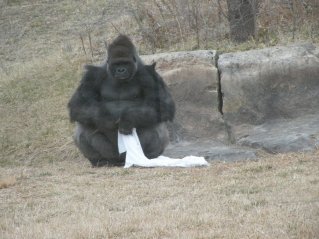
The Jungle building is one of the most popular and includes not only a real waterfall, but fruit bats flying freely and vampire bats in a dark, glassed in area.  Plants are everywhere, and the birds are free to fly and roam...and make a lot of noise.  There's the North American area, with bears and buffaloes and more, the Gorilla Forest that's so much fun to watch.  Africa and Asia, which includes the Tiger Trek, moves on to Australia and South America.  Most of the animals from those last two regions were unavailable, thanks to our colder weather here, but we'll catch them the next time.

Gorilla playing with a sheet
The exhibits are all well-marked as is the way to each area, and the information shared on each animal is fascinating.  School children from the city and surrounding school districts take trips to the zoo every year and learn new things.  And, yes, I do read those information signs.  Flamingos get their pink/orange color from eating greens that contain iodine.  I remember the flamingos at Cyprus Gardens in Florida when I was child, but I never knew until yesterday that the underside of a flamingos wings are black, thanks to them taking low flight from the shore to the pond yesterday.

While it wasn't the beautiful day forecasted, and the sun refused to come out from behind thick clouds, with a stiff breeze and 10 degrees cooler than expected, we still had a wonderful time!  Proof, once again, that time off is needed by everyone, and it doesn't take much to make some of those times memorable.
“Sometimes it's important to work for that pot of gold. But other times it's essential to take time off and to make sure that your most important decision in the day simply consists of choosing which color to slide down on the rainbow.” ~ Douglas Pagels

Thursday, January 31, 2013

Mapping Your Story

THE CREATIVE PROCESS
Last week was the pits.  Whatever the current respiratory flu is that's going around in my part of the country, it decided to visit me.  Last Wednesday and Thursday were spent sleeping most of the day away.  Friday was better---until I started to chill...and not in a good way.  My temperature hit 103.5.  I couldn't get warm.  Some ibuprofen, OTC cough medicine, and echinacea (my go-to whenever I feel something coming on) finally did the trick after three hours of shivering in bed.  I spent the weekend being a slug, and finally felt about 75% human by Tuesday.  I'm still tired, still would like to crawl between the covers, but I might begin to like that.  Now it's back to the business of writing and the creative process we go through with each story.

The word "plotting" strikes fear in the heart of many writers.  It did me for many years.  For some of those writers, not plotting can lead to stalling or writing in fits and starts or, even worse, coming to a complete stop with a story that is never finished. Or many stories that are never finished.

But plotting doesn't have to be the terror that many believe it is.  Plotting doesn't mean knowing every little detail of every scene.  It's basically nothing more than a road map of where your characters and their story are going.  Each writer has the option of how detailed that road map will be.

One caution:  Trying to plot before knowing your characters can lead to insanity.

Back in the olden days when I first decided to try my hand at crafting a story, I never plotted.  That's right, I said never.  There were a couple of reasons for that, the first being that I feared it would spoil the journey for me, and I'd lose interest.  I've learned since then that the more I know about my story, the easier the journey is.  I'm able to enjoy the process, instead of wasting time wondering what to do with my characters next.  The second reason had a lot to do with not having a clue HOW to plot.  And this is the first time I've ever admitted that. ☺

There are as many ways to plot as there are people who do it.  My fellow authors and good friends, Kristi Gold and Kathie DeNosky, both plot in their own, special way.  My way isn't their way, anymore than each of their ways is mine, but there are aspects we all share.

Kristi isn't a put-it-on-paper plotter, but once she starts going, it's solidly in her mind.  She knows what's going to happen, although only certain things seem to be detailed to her.  Still, her plotting has led to book #32 (THE CLOSER YOU GET, Harlequin Superromance, February 2013) hitting shelves in a matter of days.  She's obviously doing something right!

Kathie long ago shared her plotting method with me, and she also shares it on her website for others.  She taught me that each scene needs its own GMC, just as the characters do at the beginning of the story.  To keep her on track and able to have written over 30 books, with her newest, IN THE RANCHER'S ARMS, Harlequin Desire, coming out in April 2013.

While I can't take a photo of Kristi's brain, complete with plots and characters, I can share Kathie's index card method.


A closer view of  two cards used for one scene.

Kathie based her scene card method on Jack M. Bickham's SCENE AND STRUCTURE, but added her own little twist.  She shared it with me, and although I no longer use the actual cards in the same way, it's (luckily!) stuck in my head.  Plus, I always know that I can go back to it, if the need arises.

~  ~  ~  ~  

Next week I'll go into more detail about beginning the plotting process, but for now, check out Kathie's scene cards and Kristi's upcoming book!  Oh, yes, and in March, the 7th Hearts of Desperation series book will hit shelves!

Don't fear failure so much that you refuse to try new things. The saddest summary of a life contains three descriptions: could have, might have, and should have. ~ Louis E. Boone 

Thursday, January 17, 2013

The Creative Process

THE CREATIVE PROCESS
The Key to Inspiration

A few days ago, I received an email from a reader via the contact form on my website.  She was reading my very first book, a Silhouette Romance titled RACHEL'S RESCUER.  No way was I not smiling when I read that she liked the book, although she hadn't finished it yet.  I hope the end doesn't disappoint her.  It's one of those endings that made me smile as I wrote it.

It's been almost thirteen years since I sold that first book, even longer since I first idea of it creaped into my mind.  It also doesn't seem like it was that long ago.  Not only has Silhouette Romance been a thing of the past, but I've added a few years to my age.  Even so, writing a book is always a new and exciting process.

After some thought and missing several Mondays and Wednesdays here, I decided that instead of my usual days and topics, I'd change things around a little and share what I've learned about writing in the past 15+ years on Thursdays.  When the mood strikes, I might stop in on a Monday, Wednesday, or maybe a Friday or weekend to share something different, but I'm hoping Thursdays won't find me as Mondays--and Wednesdays--have lately, wondering how I managed to forget what day it was and have allowed the it to pass without blogging. For those who stop by more frequently, I apologize and hope the change will help.

So here we go!

From Idea to Book

The question most asked of writers is, "Where do you get your ideas?"

I haven't discovered a single writer who has been able to answer that question in less than ten words.  Unless the answer is, "Everywhere," that is, and that's an honest answer.  Ideas spring from TV, movies, songs, books, overheard conversations, photos, the evening news, and much, much more.

A lack of ideas isn't usually a problem.  It's what to do with them.  Many a writer has had an inspiring idea for a story, only to discover, once begun, that it lacked something vital and eventually found its way to the bottom desk drawer.  Some ideas work.  Others don't work, no matter how long or hard we work on them or how badly we want them to.

An idea is only the beginning.  That sliver of inspiration goes through a long, arduous process to become a full story.  It involves characters, back stories, settings, goals, dialogue, and conflict, just to name a few.  The process can involve hours spent in front of a blank screen and even more hours, days, months and sometimes years putting letters and words together that become the story on that screen.

Example

RACHEL'S RESCUER was far from the first book I wrote and obviously not my first idea, nor the first book I wrote.  But it was a viable idea and it began as a silent reply to yet another rejection.  That reply was, "They want babies, brides and cowboys?  I'll give them babies, brides and cowboys."

Yes, my inspiration was a rejection.

It didn't take long to create the characters.  The "cowboy" was a rancher in Montana.  The "bride" was a mother, and the "baby" was her six-year-old son.

Then came the questions.


  • What is one thing all mothers fear?  Answer: The loss of a child. After thinking of all the ways a child could be lost, I finally found the answer.  Aha!  Ex-in-laws (mother was a widow) were trying to take the child because...?  They had made an assumption about her and considered her (unfairly) to be a bad mother.  Conflict and Motivation for the mother.  She was on the run from them.
  • What is the rancher/hero's conflict?  Answer: He didn't believe in love and marriage and didn't want a family.  Simple, right?  But why did he feel that way?  What was his Motivation?  He'd been in a bad marriage, and his wife (an absolute opposite of the rancher) had miscarried their baby.  One important thing.  He loved kids, but didn't know or accept it.
  • Where to set the story?  Answer:  Montana.  It was a long way from where the heroine and her in-laws lived.
  • How do the H/H meet? Answer: The heroine arrives at the hero's ranch with a sheriff following.  She thinks her ex-in-laws have found her. (They haven't.) Thinking the drive leading to the ranch is a road, she dead-ends at the ranch...with a flat tire.
  • How to increase the conflict and keep the heroine there?  Answer:  A snowstorm.

That was how the story was born.

The tagline on the back cover reads: A sheriff, a snowstorm and suspicious ex-in-laws were hot on Rachel's heels...  I wish I could say I wrote that, but I didn't. ☺

 Of course more conflict arose, and the H/H could only fall in love.  It is a romance, after all. :)   But that's for another day.
Rachel's Rescuer
working title was
The Rancher and the Runaway Mom

Creativity is just connecting things. When you ask creative people how they did something, they feel a little guilty because they didn't really do it, they just saw something. It seemed obvious to them after a while. That's because they were able to connect experiences they've had and synthesize new things. - Steve Jobs

Monday, January 7, 2013

Goals are Set. Now What?


MOTIVATION MONDAYS

Today marks the official last day of the first week of the new year.  Our goals should be made.  In theory, we should be moving forward on them.

Reaching our goal is like climbing a staircase.  We start at the bottom by deciding what it is we want to accomplish, then step by step, we move toward it.  That takes motivation.  The key is knowing what each step involves so we can more easily get to the top aka Our Goal.  That's where a little planning comes in.  My goals won't be the same as another's, but there are a few steps that we all can take to make the trip easier.

As it was last year, my goal this year is a specific word count.  Because of that, I have a good idea of what I can do in that amount of time.  I set last year's goal at 120,000 words.  I included both blogging and book word count and ended up nearly doubling my goal. This year I'm sticking totally with main writing word count, which I've increased to just over last year's total.  A quick look on the right will show that I haven't made any progress yet.

Why no progress?  For nearly two weeks before Christmas and after New Year's Day, there have been five grandkids, ages 3-11, here from morning until evening.  By the time they leave, I do well to know my name.  Now that they're back in school, I can relax and work some during the day.  (3-year-old will still be here during the day.)  What I realized last night is that I've been waffling, not knowing for sure what I specifically want to work on this year.  I gave it some thought yesterday and last night, and I now have a clear idea of what I'm going to do.  Of course it can change, but I can look up that long stairway and see the top.  I know how to work my goal.

Stuck with no idea of where to start?  If you're working on a specific book/manuscript or more than one, it doesn't matter whether you've set your goal to write to the finish or if you'll use page count or word count as your goal.  By now you should have broken that big goal into smaller ones.  You should also know what you want to work on.  That puts you one step up.  Forward motion!  What's left is each of the rest of the steps aka mini-goals.  It's like losing weight.  We do it day by day, pound by pound, whether dieting or exercising or both.  Writing goals work the same way.

There are a few things that can help make the journey easier.

  1. Know what kind of story you'll be writing.  Whether it's romance, suspense, paranormal, inspirational or other, have an idea of 
  2. Know your characters.  Not just their names, but who they are, what they do, and especially where they came from.  This is where GMC comes in.  This doesn't have to be done in a day, and quite often when the writing is moving along, we often discover things about characters that we didn't know when we wrote the first words or even chapters.  Or even more often, we've had these characters in our mind for some time, growing little by little.
  3. Know where your story is going.  This doesn't mean your book must be completely plotted or even a little plotting, but if you know where it needs to start, what the main turning point will be, and some kind of an idea of how it will end, you can go from point to point more quickly and smoothly, without a major panic attack.
  4. Know when your best writing time is and write on a regular schedule.  I'm guilty of not doing this as much as I should, so it's something I need to work on.  Remember, the more often you write, the easier it becomes.  You might even get lucky and make it a habit.  If you know on Monday that you're going to be writing the second scene of chapter four on Wednesday, you can be thinking about how that scene will play out.
  5. Know in your heart that if you get behind on your mini-goals, you can still make progress and quite possibly still make your goal.  You missed a day writing on your 3-page-a-day goal?  Write one extra page for each of the next 3 days, and you're back on track.  Or give up an evening of television to make some progress.  Your goal isn't over until the time is up.
If you've found some ways to keep yourself motivated through the year-long goal, share them!  We learn not only from what we do, but from others do, too.  

Let's make 2013 the year we meet and maybe even exceed our goals.  I'm willing to try.  How about you?
Everyone has inside himself a piece of good news! The good news is that you really don’t know how great you can be, how much you can love, what you can accomplish, and what your potential is! - Anne Frank

Friday, January 4, 2013

"So it Begins."

(Correction to the December 31st post.  The third sentence should read: It's a time to reflect on the year that has passed.)


***

There it is on the left.  The blank book of a new year, waiting to be filled, one day at a time.

For me, the first four days of this new year have gone by in a blur, mostly because family has been dealing with colds and flu.  Not a pretty way to start the year.  Now that the grandkids' holiday vacation is over, they're back in school.  In fact, yesterday was the first day in almost two weeks that has been close to normal.  Whatever "normal" is.

We spent New Year's Eve playing Wii Trivial Pursuit.  My thoughts were that it was slow and boring.  That pretty much described the turnover from 2012 to 2013, too, but then we're not a rowdy bunch and missed the (rerun) of the ball dropping at midnight.  Obviously, when it comes to celebrating and welcoming in the new year, we're not the most exciting group.  It doesn't matter to me.  I've said goodbye to many years and hello to the same amount of new ones.  It's not like it's something terribly exciting that only happens in hundreds of years or even when there's a blue moon.  No, once every 365/366 days, we add another number onto the year.

Why is it that we make such a big deal of the arrival of the New Year?  As far as I could tell, there wasn't a whole lot of difference between Monday, December 31, 2012 and Tuesday, January 1, 2013.  It's not much more than replacing the old calendar with a new one.  Nothing magical happened.  I didn't suddenly lose 30 pounds or win the lottery.  I didn't even find a penny on the ground.  But I wasn't expecting anything grand, so I wasn't disappointed.  See how that works?  It was as pleasant as any other family get-together, although we did have a very small bottle of champagne to share, almost half of which was poured down the drain.

I know I should be here blogging about progress made toward my goals for the year, but I'll be honest and admit that I haven't done much.  In fact, I'm trying to think of what I have done, and I'm coming up with nothing.  I'm going to blame that on yesterday being the first day and today the second day of "normalcy."  The truth is, I could use a swift kick in the backside to get me going.  I'm sure I'll soon regret not using this time wisely and making some kind of progress, even if bad.  That's pretty much a given.  Another truth is that I'm not sure what I want to do.  Or even need to do.  I'm in a state of limbo.

So instead of writing something pithy that will light a fire under us all---something I have no right to do at this point in time, considering---I'm going to share a couple of links.  The first is one I saved some time ago, but it has a lot of good information.  I have all these links of blogs and articles that I've saved, yet I don't get back to them nearly as often as I should.  I have a feeling I'm not the only one who does this.  But this particular blog post is about procrastination, and, being the Queen of Procrastination, I feel it's probably timely for those of us who are fully aware we should be making progress, but for some reason or other are dragging our feet.    Give What's Stopping You?, from the Happy Writer, a read.  You might discover a little of yourself in it.  I do.

The second link is new and came through my email today.  I enjoy reading Kristen Lamb's Blog, and today's post is another good one.  Writing Tip #2 - Writing is Pain, Learn to Take a Hit tells it as it is.  Writing isn't easy.  The business isn't sweet.  It takes hard work and tough skin, picking yourself up and dusting yourself off, and if you don't want to deal with any of those things, leave your dream of being a writer behind and find something easier.  Underwater shark wrestling is always an option.

And while I'm here, I might as well do a little shameless promotion.  My seventh Harlequin American book set in Desperation, Oklahoma, will be out in March.  I'll share a little bit about it as time grows nearer, and also about books of my friends that will be coming out around the same time.  Until then, have a wonderful weekend and smile at the fact that the first week of a brand new year is nearly gone, and we have the rest of the year to buckle down and get some words on paper.

Having used a J.R.R. Tolkien quote as the title of this blog post, it's only fitting to add another to end it.  And quite appropriate this one is.  Enjoy!
“It is the job that is never started that takes longest to finish.” - J.R.R. Tolkien